/ 01
One interface, from approach to contact.
A humanoid must do more than reach a target. It must approach it, place its feet, coordinate its arms, and stay balanced when contact changes.
FORGE exposes these demands through a coarse-to-fine command interface: base velocity, planar foot placement, bilateral wrist poses, and optional desired wrist loads. Command groups can be used separately or together, without switching to a different whole-body controller.
Policy training requires no full-body human motion trajectories or joint-angle references. Teleoperation supplies sparse wrist poses relative to the pelvis and coarse motion commands. A frozen locomotion prior supports stability; a sensorless force-estimation pathway adapts wrist targets during sustained contact.
Preserve the locomotion prior while learning whole-body corrections.
Expose task-space targets for both stance and wrist motion.
Use estimated interaction forces to adapt position targets.
/ 02
On the robot.
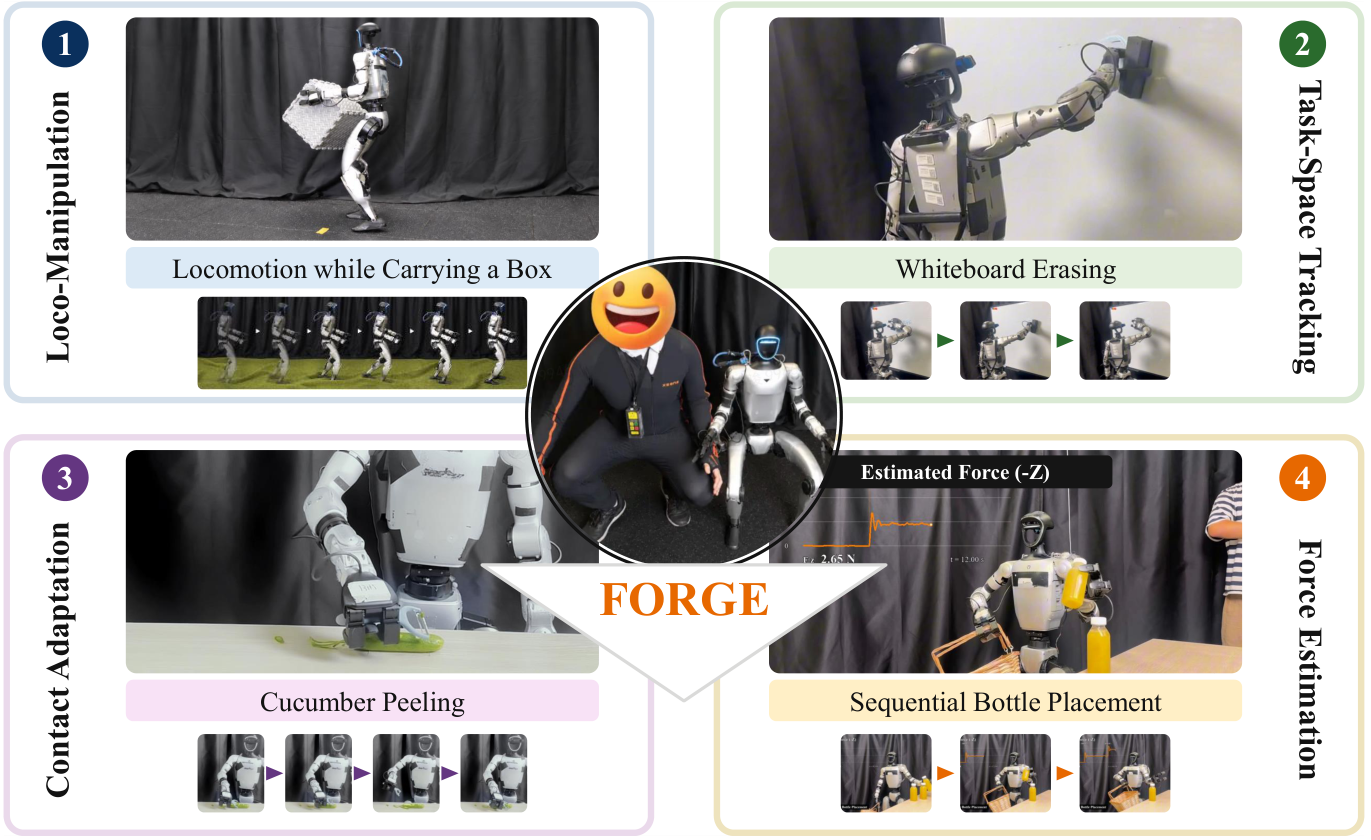
Hardware demonstrations span locomotion while carrying, whiteboard erasing, cucumber peeling, and sequential bottle placement. The video provides qualitative examples; the controlled evaluations are reported separately below.
/ 03
Sparse commands.
Coordinated whole-body control.
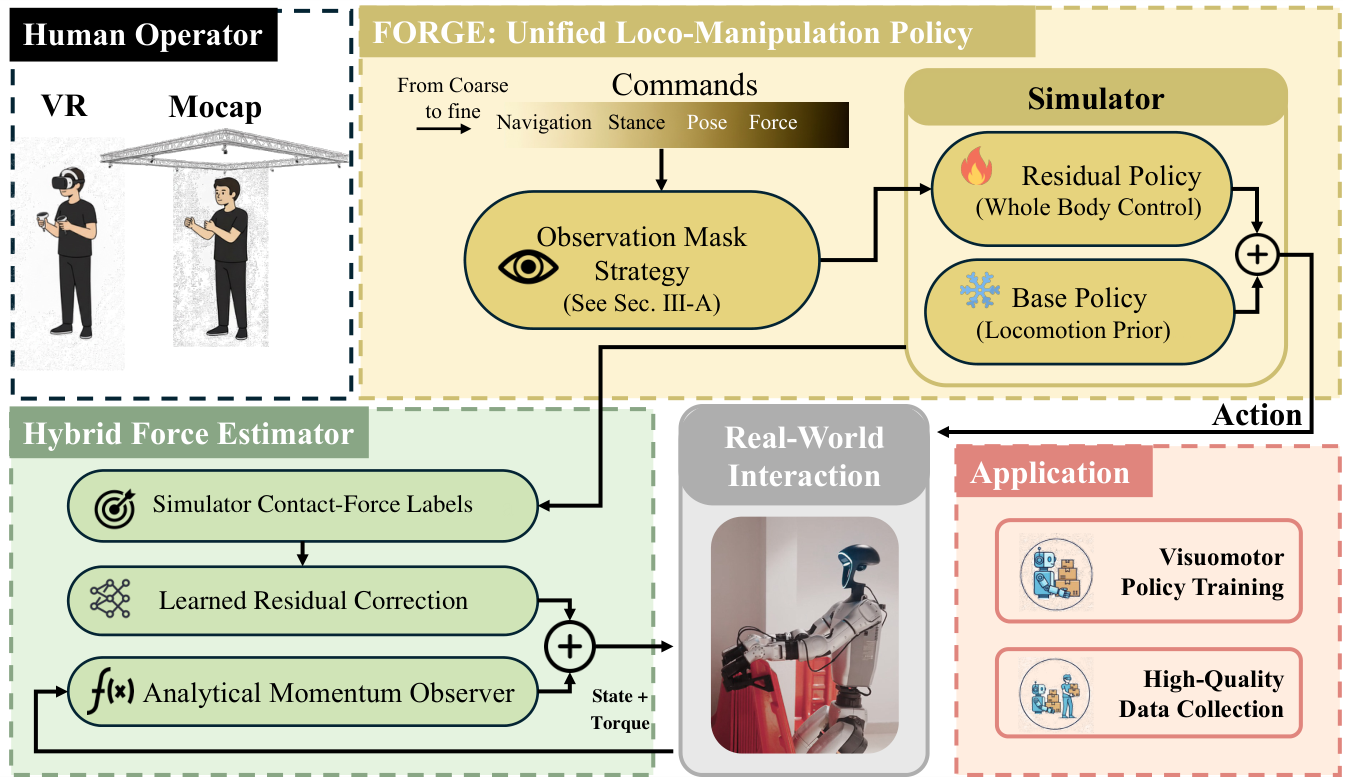
The controller combines three components: multi-granularity command masking, physics-informed force estimation with virtual-target adaptation, and asymmetric residual actions anchored on a frozen locomotion expert.
Activate only the objectives that matter.
Four task-level activation bits select Navigation, Stance, Pose, and Force. Inactive command entries are replaced with null values and their reward terms are excluded. This prevents inactive targets from competing with the current task while preserving the same 29-dimensional action semantics.
Keep the prior. Learn the correction.
A pretrained lower-body locomotion expert is frozen. The residual policy learns corrective lower-body actions and directly controls the upper body, allowing manipulation-induced posture changes without relearning walking from scratch.
Observable history at deployment.
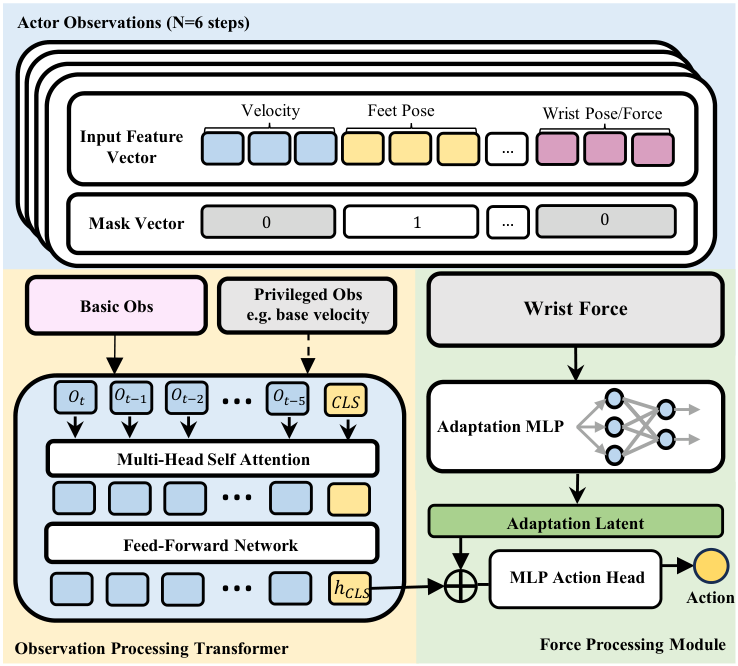
Six masked observation frames feed a shared MLP and a two-layer Transformer. An adaptation encoder supplies a second latent to the action head. Its decoder predicts a six-dimensional force correction at deployment; wrist-position and base-velocity targets provide auxiliary training supervision.
The policy runs at 50 Hz. Low-level joint targets are produced from the policy action rather than from full-body human motion references.
Training and implementation details
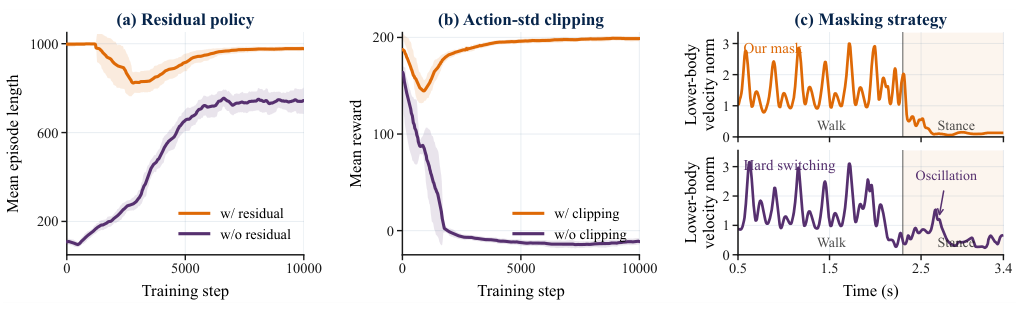
Training uses 2,048 parallel environments, 50 simulation steps per PPO update, and up to 20,000 updates per stage. Isaac Gym runs at 200 Hz with four-step decimation. PPO uses Adam with an initial learning rate of 10−3 and an adaptive schedule targeting KL 0.01. Lower-body residual action standard deviation is clipped at 0.2. See Sec. IV-A of the paper for the full randomization, gains, and optimizer settings.
/ 04
Comparison on a shared platform.
The paper compares four humanoid controllers on the same robot and target sequences. Hardware latency and tracking use 20 trials per method. A separate simulation test measures squeezing force during sustained bilateral contact with a rigid box.
| Controller | Latency ↓ms · hardware | Foot MPE ↓cm · hardware | Wrist MPE ↓cm · hardware | Contact force ↓N · simulation |
|---|---|---|---|---|
| HOMIE | 27 | N/A | N/A | 15.48 |
| TWIST2 | 197 | 7.87 | 7.76 | 17.16 |
| SONIC | 252 | 7.35 | 6.42 | 15.32 |
| FORGE | 22 | 5.42 | 4.15 | 8.52 |
Latency is command transmission to end-effector arrival, not neural-network inference time. MPE is mean position error; HOMIE has no corresponding wrist-target or foothold interface. Contact force is the bilateral mean absolute normal reaction under identical wrist-position targets. Lower force means less squeezing in this test, not more accurate force tracking.
/ 05
What keeps unified control stable?
The ablations isolate the locomotion prior, lower-body exploration clipping, and command masking. End-to-end 29-DoF learning without the prior fails to learn stable behavior in this setting; removing action-std clipping produces late reward collapse. Masking smooths the transition from walking to stance.
| Metric | Without mask | FORGE |
|---|---|---|
| Valid rollout (s) ↑ | 15.69 ± 1.32 | 19.46 ± 0.52 |
| Linear velocity error (m/s) ↓ | 0.194 ± 0.003 | 0.162 ± 0.003 |
| Planar feet MPE (m) ↓ | 0.182 ± 0.002 | 0.167 ± 0.002 |
| Wrist MPE (m) ↓ | 0.115 ± 0.003 | 0.079 ± 0.004 |
Mean ± standard deviation across 20 rollouts per variant; each rollout is capped at 20 seconds.
Balancing precision and stability.
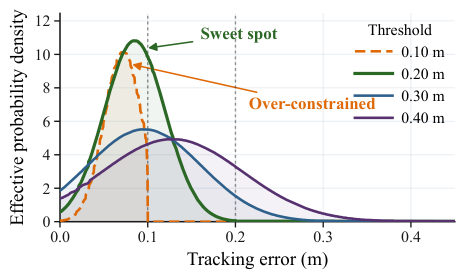
A termination-threshold sweep evaluates 0.1, 0.2, 0.3, and 0.4 m. The selected 0.2 m setting concentrates tracking errors at low values, whereas 0.3 and 0.4 m produce broader distributions with longer high-error tails.
/ 06
Estimate contact.
Adapt the target.
A momentum observer provides a structured arm-disturbance estimate. A learned correction compensates for residual model and actuation errors. Together, they estimate low-frequency, wrist-equivalent translational interaction forces from arm joint states and reconstructed PD torques—without wrist force/torque sensors.
The estimated environmental reaction and optional desired applied-force command define a quasi-static force-balance error. A virtual-target update converts this error into a wrist-position offset, which the same whole-body policy tracks.
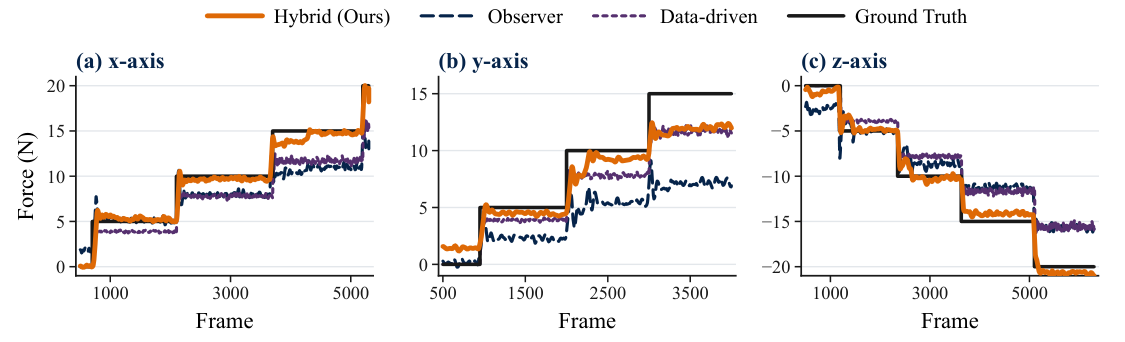
| Estimator | x axis | y axis | z axis |
|---|---|---|---|
| Hybrid (FORGE) | 0.81 / 0.50 | 1.97 / 1.57 | 0.87 / 0.67 |
| Observer-only | 2.83 / 2.29 | 5.15 / 4.43 | 3.02 / 2.58 |
| Learned-only | 2.43 / 2.19 | 2.23 / 1.92 | 2.88 / 2.47 |
Entries are RMSE / MAE in newtons for the representative traces above, not aggregate errors across all trials. Held-out vertical loads of 35, 40, and 50 N yield hybrid RMSEs of 8.28, 9.66, and 12.35 N.
Less deformation during sustained contact.
In the foam-box lifting comparison, the robot, policy weights, initial pose, nominal wrist trajectory, and lift target are held fixed. Both variants complete the lift, but enabling force feedback produces less visible deformation than tracking nominal wrist targets directly.
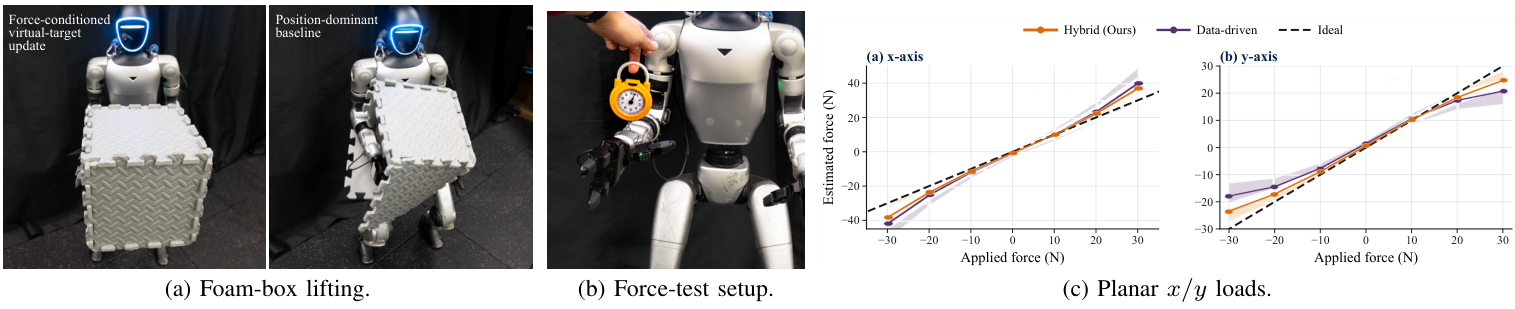
Scope: wrist-equivalent force estimation and sustained, quasi-static contact adaptation—not full-wrench sensing, dynamic impedance control, or a general force-tracking guarantee.
/ 07
Tracking through changing support and contact.
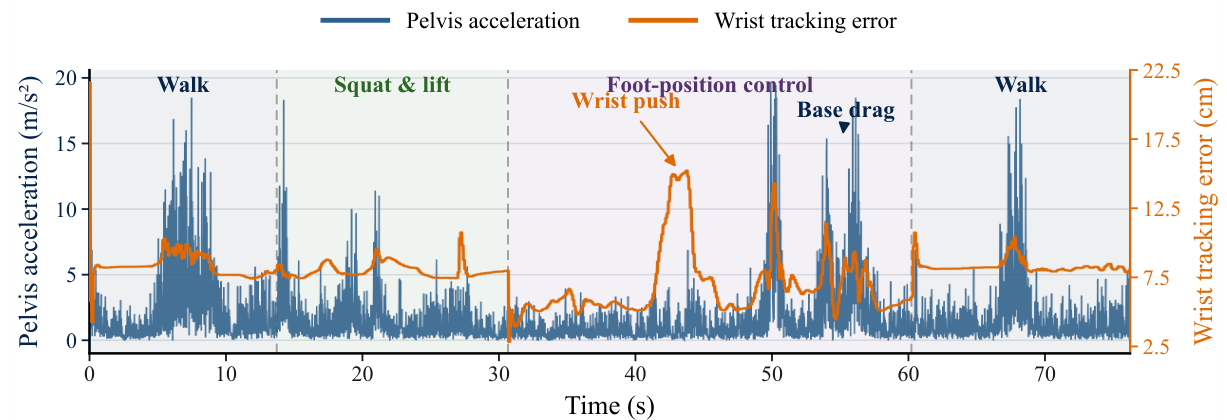
Hardware trials cover walking, squat-and-lift, and commanded planar foot placement. A separate dynamic-reaching evaluation reports wrist-position and planar foot-position RMSEs below 8 cm and 10 cm, respectively. Under the evaluated 30 N wrist push and 50 cm body drag, representative traces show transient errors followed by recovery.

/ 08
A whole-body executor for learned policies.
FORGE also serves as the joint-action executor for an upstream Diffusion Policy. The visuomotor model maps head-mounted RGB and task state to command chunks. One cross-payload model is trained on 320 demonstrations: 80 each for empty, 0.5 kg, 1 kg, and 2 kg payload conditions.
Paper Table V. Twenty hardware trials per payload. Success requires completing the prescribed squat-and-lift-box transport sequence without task termination or human intervention. Assuming independent trials, 95% Wilson intervals are 83.9–100% for 20/20 and 69.9–97.2% for 18/20. These results concern the tested task and 0–2 kg payload range.
/ 09
Read the work. Build on it.
BibTeX
@misc{xing2026forge,
  title = {FORGE: Force-Aware Multi-Granularity Control
           for Efficient Humanoid Loco-Manipulation},
  author = {Xing, Liangjun and Fan, Ke and Li, Kailin and
            Wang, Bin and Niu, Xiaojie and Ben, Qingwei and
            Cao, Jiafei and Yao, Wei and Liu, Yebin and
            Wang, Jingbo and Zhang, Weinan},
  year = {2026},
  url = {https://bb0928.github.io/forge/}
}